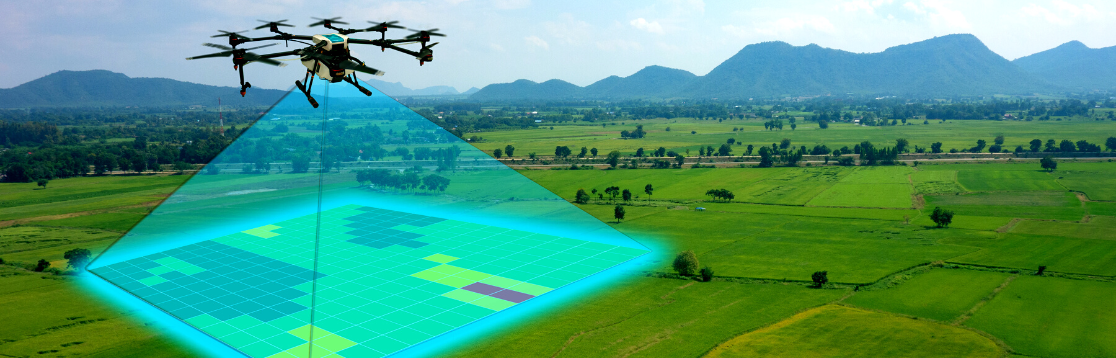

The use of drones in mapping and surveying has revolutionized how professionals capture and process geospatial data. One of the most debated questions in drone-based photogrammetry and remote sensing is: Does better positioning really improve mapping accuracy? While the intuitive answer might be yes, the reality is nuanced. Positioning whether it’s GPS, GNSS, or RTK/PPK is certainly a crucial factor, but it's just one piece of a much larger puzzle involving image quality, sensor calibration, flight planning, and data processing.
UNDERSTANDING POSITIONING IN DRONES
Positioning in drones refers to the ability to determine the precise location (latitude, longitude, and altitude) of the UAV and, more importantly, the camera at the moment each photo is taken. Most consumer drones rely on standard GPS, while professional surveying drones are often equipped with RTK (Real-Time Kinematic) or PPK (Post-Processed Kinematic) systems.
These high-precision GNSS technologies reduce location errors from several meters (typical in consumer GPS) to a few centimeters, significantly enhancing the positional data accuracy of each image or point collected. In theory, this improved accuracy should directly translate into better maps and models but the real-world relationship is more complex.
THE CHAIN OF ACCURACY
To understand whether better positioning improves mapping accuracy, it’s vital to look at the entire chain of mapping workflow:
Image Acquisition
Positioning System
Ground Control Points (GCPs)
Each of these elements contributes to the final map’s accuracy. While better positioning reduces one major source of error camera location uncertainty ignoring other elements can still result in poor-quality outputs.
RTK/PPK VS GCPS: WHAT THE RESEARCH SHOWS
Several case studies have compared the use of high-precision GNSS positioning (RTK/PPK) against the use of Ground Control Points (GCPs) to evaluate mapping accuracy. These studies show:
Thus, better positioning certainly improves results, but only if integrated into a comprehensive data collection strategy.
POSITIONAL ACCURACY VS. MAPPING ACCURACY
It’s also important to distinguish between positional accuracy (how accurate each camera position is) and mapping accuracy (how accurately features are located on the map). You can have precise camera positions, but if images are blurry, the terrain lacks features, or the photogrammetry software misaligns images, the resulting map can still be inaccurate.
That’s why mapping professionals emphasize the term "Geo- Referencing Integrity", which combines positioning with reliable visual features, GCP integration, and accurate modeling.
THE ROLE OF DRONE HARDWARE AND SOFTWARE
Not all drones are created equal. A drone with RTK capability but a poor-quality camera or weak flight controller will not yield the same accuracy as a well-calibrated mapping drone from a reputable manufacturer. Positioning technology must be matched with capable hardware including:
Likewise, Photogrammetry Software such as Pix4D, Agisoft Metashape, or DJI Terra plays a pivotal role in accuracy. Algorithms that perform tie-point matching, triangulation, and orthorectification need precise input to yield precise outputs. Garbage in = garbage out — even with high-end GNSS.
REAL- WORLD APPLICATIONS: ACCURACY REQUIREMENTS
In practical applications, different use cases require different levels of mapping accuracy:
Better positioning allows you to meet higher accuracy standards without over-relying on GCPs, which are time-consuming to set up — especially in large or remote areas. But for legal surveys or engineering-grade work, GCPs are still indispensable, regardless of GNSS precision.
CONCLUSION: IS BETTER POSITIONING THE ANSWER?
Yes - better positioning does improve mapping accuracy, but only within an integrated system. Think of it like upgrading the tires on a car: better tires help, but they won’t win races if the engine is poor or the driver is untrained. Similarly, better positioning reduces one source of error but does not guarantee perfect maps.
To truly benefit from high-accuracy positioning systems like RTK/PPK:
FINAL THOUGHT
As drone mapping becomes increasingly vital to industries like infrastructure, mining, agriculture, and urban planning, the push for better data accuracy will continue. Better positioning is not a silver bullet but when applied smartly, it enables faster, more reliable, and scalable mapping. So yes, in the right context, better positioning doesn’t just help it transforms what's possible.