
Highlight:
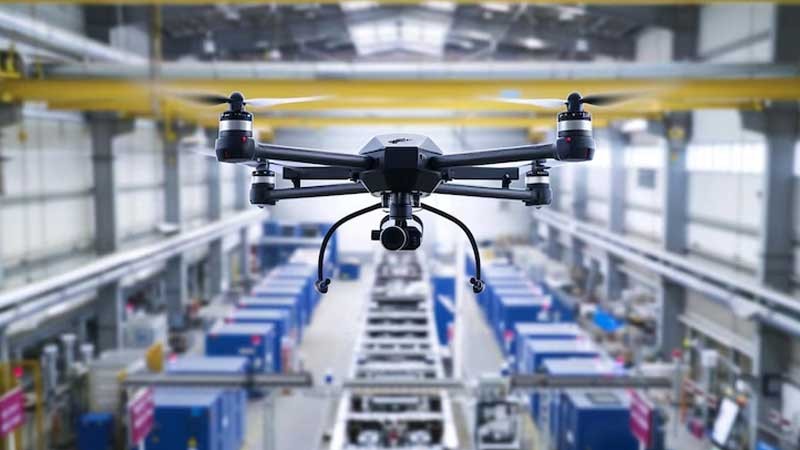
Indoor drones are transforming industrial inspection by enabling safe, efficient, and precise monitoring in confined and hazardous environments. Equipped with advanced sensors and navigation systems, they reduce human risk, improve data accuracy, and streamline maintenance processes across industries such as manufacturing, energy, warehousing, and infrastructure management in modern facilities.
The rapid advancement of drone technology has expanded its applications far beyond outdoor aerial operations, giving rise to a new category of unmanned systems designed specifically for indoor environments where traditional drones struggle due to the absence of GPS signals and confined operational spaces. Indoor drones are increasingly being adopted across industries for inspection and monitoring tasks, offering a safer, faster, and more efficient alternative to manual inspections in hazardous or hard-to-reach areas. Unlike conventional drones that rely heavily on satellite-based navigation, indoor drones utilize advanced sensor fusion technologies, including LiDAR, optical flow sensors, ultrasonic sensors, and simultaneous localization and mapping algorithms, to navigate complex indoor spaces with high precision and stability.
These systems allow drones to create real-time maps of their surroundings while continuously updating their position, enabling autonomous flight even in dynamic environments with obstacles and varying lighting conditions. One of the primary drivers behind the rise of indoor drones is the need to improve safety in industrial operations, as many inspection tasks involve significant risks to human workers, including exposure to toxic gases, high temperatures, confined spaces, and elevated structures. By deploying drones, organizations can minimize human involvement in such dangerous environments, thereby reducing the likelihood of accidents and injuries. In sectors such as oil and gas, power generation, mining, and heavy manufacturing, indoor drones are used to inspect storage tanks, boilers, pipelines, and structural components without requiring shutdowns or scaffolding, resulting in significant cost and time savings. The ability to capture high-resolution images, thermal data, and three-dimensional models further enhances the effectiveness of inspections, allowing engineers to identify defects, corrosion, leaks, and structural weaknesses with greater accuracy.
Warehousing and logistics operations are also benefiting from indoor drone technology, particularly in inventory management and facility monitoring. Drones equipped with barcode scanners and cameras can autonomously navigate warehouse aisles, scan inventory, and update records in real time, improving accuracy and reducing the labor required for manual stock checks. This capability is especially valuable in large distribution centers where inventory turnover is high and efficiency is critical. Another important application is in infrastructure inspection, where indoor drones are used to assess the condition of bridges, tunnels, and large buildings, capturing detailed data that can be analyzed to support maintenance planning and asset management. The integration of artificial intelligence and machine learning is further enhancing the capabilities of indoor drones, enabling them to perform tasks such as object recognition, anomaly detection, and predictive maintenance. For example, AI algorithms can analyze inspection data to identify patterns indicative of potential failures, allowing organizations to address issues proactively before they escalate into costly problems. Communication and control systems play a crucial role in indoor drone operations, as reliable data transmission is essential for real-time monitoring and decision making.
Many indoor drones use dedicated wireless communication networks or mesh systems to maintain connectivity within complex structures, ensuring continuous data flow even in challenging environments. Despite their advantages, indoor drones face several technical challenges that must be addressed to ensure optimal performance. Navigation in GPS-denied environments requires highly accurate sensors and robust algorithms to prevent drift and maintain stability, particularly in areas with limited visual features or reflective surfaces that can interfere with sensor readings. Battery life is another critical factor, as indoor drones must balance flight time with payload capacity and processing requirements. Advances in battery technology and energy-efficient design are helping to extend operational duration, but limitations still exist, especially for large-scale inspections.
Additionally, the design of indoor drones must account for safety features such as protective cages, collision avoidance systems, and fail-safe mechanisms to prevent damage to both the drone and the surrounding environment. Regulatory considerations are generally less restrictive for indoor drone operations compared to outdoor flights, as they are typically conducted within controlled environments; however, organizations must still adhere to workplace safety standards and ensure proper training for operators. As industries continue to embrace digital transformation, the role of indoor drones is expected to grow significantly, driven by the increasing demand for automation, data-driven decision making, and improved operational efficiency. The integration of indoor drones with building management systems, industrial Internet of Things platforms, and cloud-based analytics is creating new opportunities for real-time monitoring and smart facility management. These interconnected systems enable seamless data sharing and analysis, providing valuable insights that support maintenance, safety, and performance optimization. Looking ahead, ongoing advancements in sensor technology, artificial intelligence, and robotics will further enhance the capabilities of indoor drones, enabling them to operate with greater autonomy, accuracy, and reliability.
Swarm technology may also be applied to indoor environments, allowing multiple drones to collaborate on large-scale inspections and monitoring tasks, further improving efficiency and coverage. In conclusion, the rise of indoor drones for industrial inspection and monitoring represents a significant shift in how organizations approach maintenance and safety, offering a powerful tool that combines advanced technology with practical benefits, reducing risks, lowering costs, and enabling more informed decision making in complex industrial environments.
